
Nollywood actor Pete Edochie has dismissed fresh rumours about his death. Recall that reports recently broke that the veteran moviestar had been rushed to the hospital and died, with claims that his son, Uche Edochie, confirmed the news on social media.
Reacting, Edochie described the claims as false and recurring, stressing that he is still very much alive and kicking.
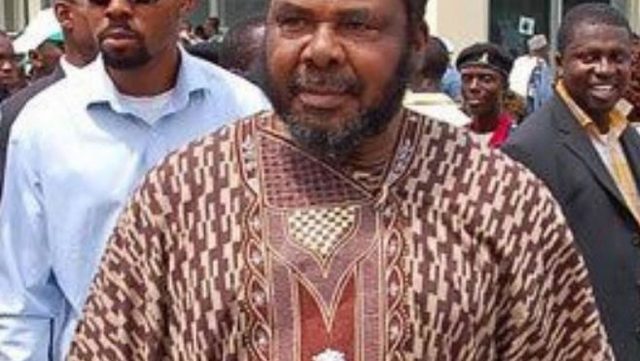
He added that similar false reports about his death have surfaced several times over the years, and he is tired of responding to such claims.
His words, “I’m alive and will die when my maker calls me home.
I have been killed about seven times. There was a time they said I travelled abroad and died there. At other times, they said that the plane I boarded from Enugu to Ethiopia suddenly crashed and I didn’t survive.
There was also a day, my wife woke up to prepare for church service, when her telephone rang and the caller said he heard that I passed away this morning. Last year, somebody from Ghana alleged that Pete Edochie was already in the grave.
However, there was something late Nnamdi Azikwe taught me when I interviewed him.
He said that anybody who’s wishing you death will die before you. All those people that wished Zik death died before him. That was what I learnt from Zik. On the 7th of March, I will be 79. My father died at 96, so we have longevity in my family.”
WOW.
Nollywood is a sobriquet that originally referred to the Nigerian film industry. The origin of the term dates back to the early 2000s, traced to an article in The New York Times. Due to the history of evolving meanings and contexts, there is no clear or agreed-upon definition for the term, which has made it a subject to several controversies.
The origin of the term “Nollywood” remains unclear; Jonathan Haynes traced the earliest usage of the word to a 2002 article by Matt Steinglass in the New York Times, where it was used to describe Nigerian cinema.
Charles Igwe noted that Norimitsu Onishi also used the name in a September 2002 article he wrote for the New York Times. The term continues to be used in the media to refer to the Nigerian film industry, with its definition later assumed to be a portmanteau of the words “Nigeria” and “Hollywood”, the American major film hub.
Film-making in Nigeria is divided largely along regional, and marginally ethnic and religious lines. Thus, there are distinct film industries – each seeking to portray the concern of the particular section and ethnicity it represents. However, there is the English-language film industry which is a melting pot for filmmaking and filmmakers from most of the regional industries.
Support InfoStride News' Credible Journalism: Only credible journalism can guarantee a fair, accountable and transparent society, including democracy and government. It involves a lot of efforts and money. We need your support. Click here to Donate