
The administration of President Bola Ahmed Tinubu, which assumed office on 29 May 2023, has presided over one of the most far-reaching periods of structural realignment in Nigeria’s recent political economy.
From the start, the presidency introduced fiscal and monetary measures to address long-standing inefficiencies in how public resources are managed. These measures, often described in shorthand as ‘Tinubunomics’, rested on two principal pillars: the immediate removal of the petrol subsidy and the unification of the country’s multiple foreign exchange windows.1 By April 2026, the administration had reached a turning point at which the initial shocks of the reforms were being met with the first signals of macroeconomic stabilisation, even as questions about the social cost of the adjustment remained at the centre of public debate.2
The strategic intent of the ‘Renewed Hope’ agenda has been to move Nigeria away from a consumption-driven model that relied heavily on subsidies and managed currency arrangements towards a production-oriented economy supported by market signals and private investment. A marked consolidation of political authority has accompanied this transition. Following the Supreme Court’s affirmation of the President’s election victory in October 2023, the ruling All Progressives Congress (APC) steadily expanded its parliamentary footprint through political alliances and a wave of defections.4 By March 2026, reporting indicated that the APC had reached approximately 84 of the 109 seats in the Senate and around 231 of the 360 seats in the House of Representatives, a configuration that placed the party close to or above the two-thirds threshold required for major legislative action.5 This dominance has helped to ease the passage of annual budgets and successive Finance Acts, including reforms to taxation and digital services levies.4
Macroeconomic Evolution and Fiscal Stability
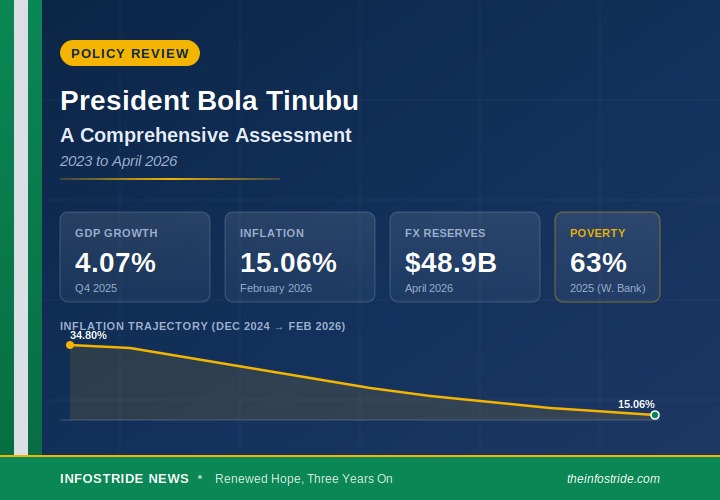
The economic landscape between 2023 and early 2026 was shaped by efforts to manage inflationary pressures following the initial reform shocks. The removal of the petrol subsidy was almost immediately reflected in higher transport and energy costs, which spread through the rest of the economy. Headline inflation, already elevated before the reforms, rose above 30 per cent during late 2023 and remained high throughout 2024.6 The response combined sustained monetary tightening by the Central Bank of Nigeria (CBN) with a rebasing of the Consumer Price Index (CPI) carried out in late 2025 to better reflect contemporary consumption patterns.6
By December 2025, headline inflation had moderated to 15.15 per cent, a sharp fall from 34.80 per cent recorded a year earlier.2 Part of this decline reflected base effects from the previous year’s price surges and improved efficiency in the foreign exchange market. The National Bureau of Statistics (NBS) subsequently reported that headline inflation had eased further to 15.06 per cent in February 2026, the lowest level since November 2020.8 Despite this statistical moderation, food costs remained a pressing concern for many low-income households, with food inflation standing at 12.12 per cent in February 2026, even as it remained well below the 26.98 per cent recorded a year earlier.8 The disconnect between cooler headline numbers and the lived experience of households is a recurring theme in commentary from both supporters and critics of the reform programme.
National macroeconomic indicators (2021–2026)
The table below summarises the principal economic metrics across the pre-reform period and the first three years of the administration. The 2026 column reflects projections or first-quarter data, as indicated.
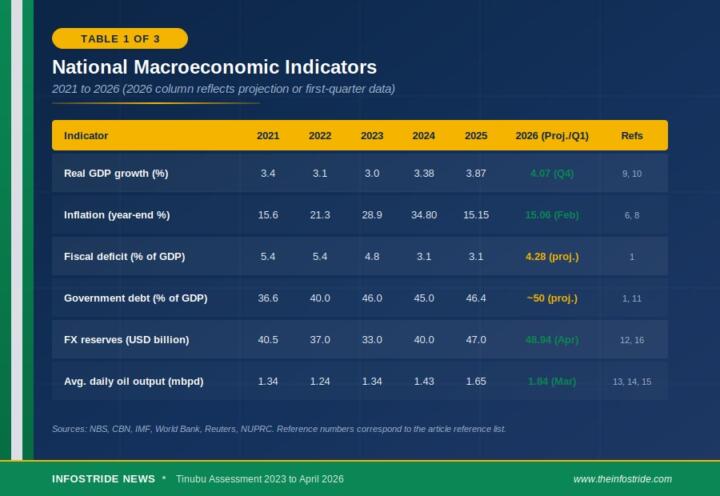
The recovery in real GDP growth has been one of the more visible markers of progress under the Renewed Hope agenda. In the fourth quarter of 2025, the Nigerian economy expanded by 4.07 per cent, supported by a robust services performance and a steady recovery in oil production.9 The non-oil sector, particularly information and communication, financial institutions, and trade, continued to anchor the economy.10 This shift suggests a gradual diversification of the economic base. However, the heavy reliance on services means that headline growth has not yet translated into a commensurate pace of formal job creation.
Foreign Exchange Reforms and External Position
The unification of the foreign exchange windows in June 2023 was intended to remove the arbitrage opportunities that had distorted the market and drained reserves under previous arrangements. The transition was turbulent: the naira underwent a substantial depreciation, falling from approximately ₦460 per dollar to over ₦1,500 in early 2025.12 By April 2026, the currency had shown signs of stabilisation, closing at around ₦1,371 per dollar in the official market in early April 2026.12
External reserves have improved meaningfully, providing the central bank with a wider buffer against currency volatility. Reserves rose from about $33 billion in 2023 to $47 billion by late 2025. They were reported at $48.94 billion in April 2026.12, 16. Higher oil receipts have supported this accretion, the issuance of sovereign bonds and steady diaspora remittance inflows.16 The Central Bank of Nigeria has projected that reserves could reach about $51 billion by the end of 2026, aided by the lower foreign exchange demand expected as domestic refining capacity expands.17
The Dangote Refinery has played a notable role in this external rebalancing. As the facility scales up towards its design capacity of 650,000 barrels per day, with possible later expansion, Nigeria’s reliance on imported petroleum products is expected to ease.11 This is expected to reduce foreign exchange outflows on fuel imports and support a more stable supply of refined products, with potential second-order benefits for transport and logistics costs. Independent analysts have cautioned, however, that the full effect on domestic pump prices will depend on a range of factors, including crude pricing, distribution costs and competition in the downstream market.
The Social Picture: Poverty and the Labour Environment
Despite the improvements in macroeconomic indicators, social outcomes during the reform era have been challenging. The World Bank’s April 2026 Nigeria Development Update reported that the share of Nigerians living below the national poverty line had risen from 56 per cent in 2023 to 61 per cent in 2024 and 63 per cent in 2025, equivalent to about 140 million people.2, 3 The disconnect between rising GDP and rising poverty rates is one of the central challenges confronting policymakers, and reflects the cumulative impact of earlier inflation spikes on household incomes. The same report projects a gradual decline in the poverty rate from 2026 onwards, but warns that progress will remain slow without stronger job creation and improvements in agricultural productivity.2
The 2024 National Minimum Wage and implementation realities
In response to the erosion of real incomes and the threat of widespread industrial action, the federal government entered into a prolonged negotiation with organised labour. This led to the National Minimum Wage Amendment Act 2024, which President Tinubu signed into law on 29 July 2024, raising the national minimum wage from ₦30,000 to ₦70,000 per month.19, 20
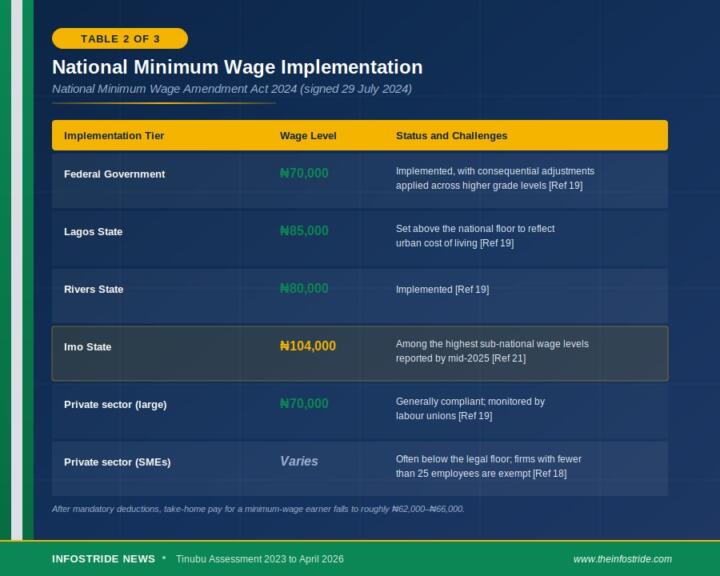
Implementation has been uneven across the federation. Federal civil servants and employees in higher-revenue states such as Lagos and Rivers received the new rate relatively quickly, while several other states have struggled with the fiscal burden. Reports indicate that some workers continue to earn rates close to the previous ₦30,000 floor, with state authorities citing revenue pressures and existing debt obligations.19 Because the law exempts establishments with fewer than 25 employees, a significant share of the workforce in the informal and small enterprise sector remains outside the new statutory protection.18
The real-term value of the ₦70,000 wage has also been a point of debate. Analysis suggests that after mandatory deductions for pension contributions and the National Housing Fund, take-home pay for a minimum-wage earner falls into a range of approximately ₦62,000 to ₦66,000.19 With food prices having risen sharply during the recent inflation episode, the purchasing power of this wage remains significantly below historical comparators when adjusted for inflation.18
Security and Regional Stability: A Multi-Front Challenge
Security has remained one of the most demanding policy areas for the administration. Persistent violence in the northern and central regions has weighed on agricultural productivity and investor confidence. The government has pursued a strategy of increased defence spending and intensified counter-operations, while acknowledging the difficulty of fully containing the threat in the short term.23
The Northwest and North Central
In the Northwest, the long-running crisis of banditry and kidnap-for-ransom has hardened into a sophisticated criminal enterprise. The Centre for Democracy and Development’s West Africa Security Tracker reported that thousands of people were abducted across the Northwest between July 2024 and June 2025, with the region accounting for the majority of nationwide incidents in that period.22 Zamfara has been among the worst-affected states, followed by Kaduna and Katsina.22
The March 2024 abduction of pupils in Kuriga, Kaduna State, brought renewed attention to the vulnerability of rural educational institutions. Initial reports cited figures of close to 287 schoolchildren taken; subsequent verification by state authorities and humanitarian agencies found that more than 130 children were rescued and reunited with their families following a coordinated security operation.24, 25 The discrepancy in the early reporting underscores how difficult it can be to verify casualty and victim numbers in conflict-affected zones.
In the North Central, intercommunal violence involving nomadic herders and farming communities has continued to claim lives. Plateau State, in particular, suffered a devastating wave of attacks beginning in late December 2023. While initial Christmas Eve attacks were reported to have killed around 140 to 150 people, cumulative reporting in the following weeks suggested that several hundred people had been killed across Mangu, Bokkos and Barkin Ladi local government areas, with thousands more displaced to camps in Plateau and neighbouring states. 26, 27
The Northeast
The Northeast remains the principal theatre of the long-standing insurgency. The military has reported successes through joint operations such as ‘Lake Sanity’, though insurgent groups have retained the capacity to launch large-scale attacks on civilian targets.28 In September 2024, a major raid took place in Tarmuwa Local Government Area of Yobe State, in which dozens of civilians were killed, with reporting at the time indicating a death toll of at least 81 in the immediate aftermath.29 The attack was widely interpreted as a reprisal for the community’s refusal to comply with illegal levies imposed by armed groups.
The humanitarian dimension of this insecurity is acute. The World Food Programme has reported that millions of Nigerians face acute food insecurity, with particularly severe conditions for children in the Borno, Adamawa and Yobe (BAY) states, where rates of severe acute malnutrition have remained alarmingly high. 30, 31 Insecurity has also constrained the distribution of humanitarian aid, with several supply routes affected by the threat of improvised explosive devices.27
Industrial and Sectoral Performance
The Nigerian economy in 2026 reflects a deepening structural divide. While services have expanded robustly, the productive sectors of agriculture and manufacturing have continued to face significant headwinds tied to power supply constraints, the cost of finance and the security situation in parts of the country.
Oil and gas: rebound and structural questions
The petroleum sector recorded a notable recovery in early 2026. After a dip in production during February, output rose to about 1.84 million barrels per day in March, supported by the reopening of previously shut-in wells and improved surveillance of oil pipelines.14, 15 The Minister of Finance has urged the Nigerian Upstream Petroleum Regulatory Commission (NUPRC) to accelerate production towards the longer-term target of 2.0 million barrels per day to support fiscal stability.14
The sector nonetheless remains vulnerable to crude theft and infrastructure decay. The administration has sought to address these challenges by implementing the Petroleum Industry Act and offering fiscal incentives for deep-water exploration and production.13 The release of updated reserves data by the NUPRC in early 2026 confirmed the continuing potential of mature basins. However, industry experts caution that fresh discoveries typically take several years to translate into production volumes.32, 42
Manufacturing and services
The manufacturing sector remains under pressure despite being a significant source of government revenue. According to NBS data, the sector contributed approximately ₦1.17 trillion in Value Added Tax in 2025, up substantially from the previous year, even as its share of real GDP held broadly stable.33 Manufacturers have continued to cite inadequate power supply, high logistics costs and insecurity as their most pressing constraints.
Services, which comprise more than half of the economy on a value-added basis, have been the main beneficiaries of the administration’s digital economy initiatives. Financial services, ICT and trade expanded robustly through the fourth quarter of 2025.9 The banking sector has also been strengthened by a recapitalisation exercise, with the Central Bank requiring banks with international authorisation to meet a ₦500 billion capital threshold by 31 March 2026.34 By early 2026, most of the largest banks had reportedly already met or substantially progressed towards these requirements, supported by sizeable capital-raising programmes.34
Governance and Institutional Capacity
The administration has governed with a relatively centralised executive style. This approach has helped to push through complex reforms quickly. However, it has also drawn commentary from civil society and analysts about the importance of maintaining transparency and effective checks and balances.38 Nigeria’s score of 26 out of 100 on the 2025 Corruption Perceptions Index, published by Transparency International in early 2026, suggests that perceptions of corruption have remained broadly unchanged, with the country slipping two places to 142nd globally.35
Government agencies have reported significant asset recoveries through the Economic and Financial Crimes Commission’s work, while critics argue that anti-corruption enforcement should be applied more consistently.35, 36 The 2025 review by the Civil Society Legislative Advocacy Centre highlighted persistent challenges in the power and security sectors, as well as concerns about judicial independence.36 In a notable institutional milestone, Nigeria was removed from the Financial Action Task Force grey list following the implementation of an action plan on anti-money-laundering and counter-terrorism financing, which authorities and external observers have described as an important step for the country’s financial credibility.38
Foreign Policy and Global Integration
The most prominent foreign policy event of 2026 was President Tinubu‘s state visit to the United Kingdom on 18 and 19 March 2026. Reporting from both governments confirmed that this was the first state visit by a Nigerian head of state to the UK in 37 years, since 1989.37, 38 King Charles III hosted the President and the First Lady at Windsor Castle for the formal ceremonial elements of the visit, which combined symbolic diplomacy with substantive bilateral engagement.38, 45
Key outcomes of the March 2026 UK state visit
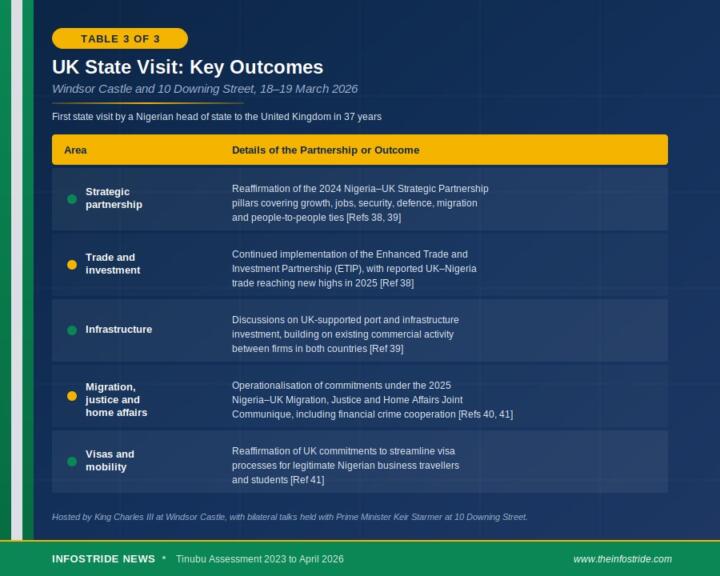
The visit also included a bilateral meeting with British Prime Minister Keir Starmer at 10 Downing Street, where discussions reportedly focused on cooperation against instability in the Sahel and on digital approaches to border management.39 Independent commentary, including from Chatham House, has cautioned that diplomatic visibility needs to be matched by progress on domestic insecurity and governance reforms to translate into investment outcomes fully.38, 46
Beyond the United Kingdom, Nigeria has continued to deepen its engagement with China, with bilateral trade reportedly exceeding $22 billion by late 2025.38 The administration has framed Nigeria as a ‘Commonwealth partner’ while seeking to maintain a balanced approach to its relations with other global powers and its role within OPEC+.
Risks and Future Scenarios
As the administration approaches the final year of its first term, several risks deserve close attention. The principal macroeconomic risk is the continued sensitivity of the federal budget and the currency to fluctuations in global oil prices. A sustained decline in crude prices would put pressure on external reserves and could weigh on the country’s credit profile, even after recent positive sovereign rating actions.11
Security remains the most consequential risk to long-term stability. The continued displacement of civilians and the disruption of agriculture in affected regions could deepen the social challenges already documented by the World Bank and humanitarian agencies (23, 27 Furthermore, as the 2027 elections approach, fiscal pressures associated with election spending could test the current path of consolidation.43
Conclusion and Strategic Directions
The administration of President Bola Tinubu from 2023 to April 2026 marked a significant economic restructuring. The removal of the petrol subsidy and the liberalisation of the exchange rate were difficult but necessary corrections to a fiscal model that had become unsustainable. The resulting macroeconomic stabilisation, characterised by a return of GDP growth above 4 per cent and a substantial rise in foreign reserves, suggests that the Renewed Hope agenda is beginning to deliver structural dividends. 9, 11
At the same time, the social cost of the adjustment cannot be set aside. The increase in absolute poverty and the persistent insecurity in parts of the country represent a significant test of the social contract. To sustain the gains of the past three years and share them broadly, we’ll focus on several priorities in the period ahead. The first is strengthening social safety nets, so that the fiscal space created by removing the subsidy translates into measurable relief for the most vulnerable through expanded cash transfers and food assistance. The second is a more durable approach to the root causes of insecurity, in which the security forces are supported by community policing and longer-term peacebuilding efforts that address the underlying disputes between herders and farmers in affected areas.
The third priority is greater investment in agriculture and local production to reduce the structural reliance on imports and to provide stronger support to the smallholders and small manufacturers most affected by the recent inflation episode. The fourth is the continued deepening of institutional transparency, including consistent application of anti-corruption rules and the publication of credible audits of revenue-generating agencies such as NNPC Limited.
On balance, the administration’s trajectory is at a delicate yet constructive point. If the gap between macroeconomic recovery and social welfare can be narrowed, the period may be remembered as one in which Nigeria placed itself on a more sustainable path. If not, the costs of the adjustment may come to be seen as having outweighed its benefits. The next twelve months are likely to be decisive in shaping that judgement.
References
- Reuters: Nigeria projects 2026 deficit of 4.28% of GDP as Tinubu proposes spending plan (19 December 2025). https://www.reuters.com/world/africa/nigeria-projects-2026-deficit-428-gdp-tinubu-proposes-spending-plan-2025-12-19/
- Nairametrics: Nigeria’s poverty rate hits 63% in 2025 despite inflation slowdown – World Bank (10 April 2026). https://nairametrics.com/2026/04/10/nigerias-poverty-rate-hits-63-in-2025-despite-inflation-slowdown-world-bank/
- Vanguard News: Nigeria’s poverty rate climbs to 63% despite easing inflation – World Bank (April 2026). https://www.vanguardngr.com/2026/04/nigerias-poverty-rate-climbs-to-63-despite-easing-inflation-world-bank/
- Arise News: APC tightens grip on National Assembly as Senate defections push party near two-thirds majority. https://www.arise.tv/apc-tightens-grip-on-national-assembly-as-senate-defections-push-party-near-two-thirds-majority/
- ThisDay: As three more PDP senators join APC, party almost has 2/3 majority in NASS (12 March 2026). https://www.thisdaylive.com/2026/03/12/as-three-more-pdp-senators-join-apc-party-almost-has-2-3-majority-in-nass/
- Trading Economics: Nigeria Inflation Rate (historical and current series). https://tradingeconomics.com/nigeria/inflation-cpi
- TheCable: Nigeria’s inflation rate now 15%, says NBS. https://www.thecable.ng/nigerias-inflation-rate-now-15-says-nbs/
- Voice of Nigeria: Nigeria’s headline inflation eases to 15.06% in February – NBS. https://von.gov.ng/nigerias-headline-inflation-eases-to-15-06-in-february-nbs/
- Premium Times: Nigeria’s economy grows 4.07% in Q4 2025 as non-oil sector drives expansion – NBS. https://www.premiumtimesng.com/business/business-news/860155-nigerias-economy-grows-4-07-in-q4-2025-as-non-oil-sector-drives-expansion-nbs.html
- Punch: Services drive GDP growth to 4.07% in Q4 2025 – NBS. https://punchng.com/services-drive-gdp-growth-to-4-07-in-q4-2025-nbs/
- Businessday NG: Five things to know as Fitch upgrades Nigeria’s rating to stable. https://businessday.ng/news/article/five-things-to-know-as-fitch-upgrades-nigerias-rating-to-stable/
- Businessday NG: Naira rebounds amid $1.08bn loss in reserves. https://businessday.ng/news/article/naira-rebounds-amid-1-08bn-loss-in-reserves/
- Oilfield Technology: Nigeria’s oil and gas industry expands as crude and condensate production reaches 554.4 million bbls in 2025. https://www.oilfieldtechnology.com/drilling-and-production/30012026/nigerias-oil-and-gas-industry-expands-as-crude-and-condensate-production-reaches-5544-million-bbls-and-gas-output-grows-by-75-billion-ft3d-in-2025/
- Punch: Oil production rises to 1.8mbpd – NUPRC. https://punchng.com/oil-production-rises-to-1-8mbpd-nuprc/
- Vanguard News: Nigeria’s oil output rebounds to 1.84mbpd as Edun commends NUPRC. https://www.vanguardngr.com/2026/04/nigerias-oil-output-rebounds-to-1-84mbpd-as-edun-commends-nuprc/
- Businessday NG: External reserves seen rising to $51.04bn in 2026 on reduced FX pressure (CBN). https://businessday.ng/business-economy/article/external-reserves-to-grow-to-51-04bn-in-2026-on-reduced-fx-pressure-cbn/
- APAnews: CBN projects Nigeria’s foreign exchange reserves to hit $51bn by 2026. https://apanews.net/cbn-projects-nigerias-foreign-exchange-reserves-to-hit-51bn-by-2026/
- Punch: N70,000 minimum wage has lost value as naira falls – US report. https://punchng.com/n70000-minimum-wage-has-lost-value-as-naira-falls-us-report/
- The Guardian (Nigeria): What is Nigeria’s minimum wage?. https://guardian.ng/nigerian/what-is-nigerias-minimum-wage/
- Gresyndale Legal: Legal impact of Nigeria’s new minimum wage. https://gresyndale.com/legal-implication-of-the-new-minimum-wage-in-nigeria/
- Premium Times: Nigerian governor approves N104,000 minimum wage for workers. https://www.premiumtimesng.com/news/headlines/816824-nigerian-governor-approves-n104000-minimum-wage-for-workers.html
- Centre for Democracy and Development: West Africa Security Tracker, Mid-Year 2025 Report. https://www.cddwestafrica.org/reports/west-africa-security-tracker-mid-year-security-report-2025/
- Human Rights Watch: World Report 2026 – Nigeria. https://www.hrw.org/world-report/2026/country-chapters/nigeria
- UNICEF: Nigeria Flash Response Report – Kaduna School Abduction Response (March–May 2024). https://www.unicef.org/media/158721/file/Nigeria-Flash-Response-Report-Kaduna-School-Abduction-Response-March-to-May-2024.pdf
- Associated Press: More than 130 abducted schoolchildren in Nigeria are returning home after weeks in captivity. https://apnews.com/article/kaduna-kuriga-schoolchildren-kidnapping-091c4f8027451e78196c850e94f4735d
- ReliefWeb: In Nigeria’s Plateau State, communal violence requires a locally led solution. https://reliefweb.int/report/nigeria/nigerias-plateau-state-communal-violence-requires-locally-led-solution
- UNICEF: Nigeria Humanitarian Situation Report (31 December 2024). https://www.unicef.org/media/167896/file/Nigeria-Humanitarian-SitRep-31-December-2024.pdf.pdf
- Human Rights Watch: World Report 2025 – Nigeria. https://www.hrw.org/world-report/2025/country-chapters/nigeria
- VOA: At least 81 killed in Nigeria in suspected Boko Haram attack, officials say. https://www.voanews.com/a/at-least-81-killed-in-nigeria-in-suspected-boko-haram-attack-officials-say-/7770651.html
- World Food Programme: Nigeria country page. https://www.wfp.org/countries/nigeria
- ReliefWeb: Nigeria – Borno, Adamawa and Yobe (BAY) states Situation Report, 20 February 2025. https://reliefweb.int/report/nigeria/nigeria-borno-adamawa-and-yobe-bay-states-situation-report-20-feb-2025
- NUPRC: Media release on the national annual petroleum reserves position as at 1 January 2026. https://www.nuprc.gov.ng/media-release-on-the-national-annual-petroleum-reserves-position-as-at-1st-january-2026/
- Nairametrics: Manufacturing sector records N1.17 trillion VAT revenue in 2025 – NBS. https://nairametrics.com/2026/04/11/manufacturing-sector-records-n1-17-trillion-vat-revenue-in-2025-nbs/
- S&P Global Ratings: Nigerian Banking Outlook 2026. https://www.spglobal.com/ratings/en/regulatory/article/nigerian-banking-outlook-2026-banks-face-regulatory-headwinds-but-will-be-able-to-preserve-positive-profitability-s101663153
- Premium Times: Nigeria drops two places to 142nd in 2025 corruption ranking. https://www.premiumtimesng.com/news/top-news/855542-nigeria-drops-two-places-to-142nd-in-2025-corruption-ranking-trails-33-african-countries.html
- PRNigeria/CISLAC: Nigeria retains a low score in the 2025 Corruption Index as global ranking slips. https://prnigeria.com/2026/02/10/nigeria-corruption-index/
- The Royal Family: Announcement of a state visit by the President of the Federal Republic of Nigeria. https://www.royal.uk/news-and-activity/2026-02-10/announcement-of-a-state-visit-by-the-president-of-the-federal-republic
- House of Commons Library: Nigerian Presidential state visit to the UK in March 2026. https://commonslibrary.parliament.uk/research-briefings/cbp-10557/
- Chatham House: Tinubu’s UK state visit – diplomacy alone won’t fix Nigeria’s problems. https://www.chathamhouse.org/2026/03/tinubus-uk-state-visit-diplomacy-alone-wont-fix-nigerias-problems
- Vanguard News: Tinubu’s state visit to the UK was strategic – Bianca Ojukwu. https://www.vanguardngr.com/2026/03/tinubus-state-visit-to-uk-was-strategic-bianca-ojukwu/
- GOV.UK: Nigeria–United Kingdom Migration, Justice, and Home Affairs Dialogue 2025 – Joint Communique. https://www.gov.uk/government/publications/nigeria-uk-migration-justice-and-home-affairs-dialogue-2025/nigeria-united-kingdom-migration-justice-and-home-affairs-dialogue-2025-joint-communique
- Businessday NG: Nigeria, UK sign new pact on deportation, financial crimes, others. https://businessday.ng/news/article/nigeria-uk-sign-new-pact-on-deportation-financial-crimes-others/
- Channels TV: Nigeria can grow oil production by 100,000bpd over the next few months – Ojulari. https://www.channelstv.com/2026/03/24/nigeria-can-grow-oil-production-by-100000-bpd-over-next-few-months-ojulari/
- Punch: Nigeria’s fiscal deficit to widen with election spending – Fitch. https://punchng.com/nigerias-fiscal-deficit-to-widen-with-election-spending-fitch/
- Channels TV: Nigeria’s inflation rate drops marginally to 15.06% in February. https://www.channelstv.com/2026/03/16/nigerias-inflation-rate-drops-marginally-to-15-06-in-february/
- Al Jazeera: Nigeria’s President Tinubu meets royals in historic UK state visit. https://www.aljazeera.com/news/2026/3/18/nigerias-president-tinubu-meets-royals-in-historic-uk-state-visit
- The Guardian (Nigeria): Tinubu’s UK visit – between diplomacy and governance. https://guardian.ng/opinion/editorial/tinubus-uk-visit-between-diplomacy-and-governance/
- Full Speech: President Tinubu’s Address At UK’s State Banquet in His Honour at Windsor Castle. https://www.theinfostride.com/full-speech-president-tinubus-address-at-uks-state-banquet-in-his-honour-at-windsor-castle/
- Full Speech: King Charles III Welcomes President Tinubu, Says Nigerian Heritage Now At The Heart Of British Life. https://www.theinfostride.com/full-speech-king-charles-iii-welcomes-president-tinubu-says-nigerian-heritage-now-at-the-heart-of-british-life/
Editorial Notes: This assessment was prepared for publication by InfoStride News (https://www.theinfostride.com). It is based on publicly available data from official sources, international organisations, and credible media reports up to April 2026.
Support InfoStride News' Credible Journalism: Only credible journalism can guarantee a fair, accountable and transparent society, including democracy and government. It involves a lot of efforts and money. We need your support. Click here to Donate