
Nollywood actress Ayo Adesanya has said that surviving domestic violence inspired her to start her podcast, “Real Life With Aunty Ayo.” She recently had her say during an interview with Saturday Beats, and fans have been reacting.
Revealing that her motivation is rooted in a desire to create a safe space for learning and healing, Ayo stated that the opportunity to have people open up to her is incredibly meaningful.
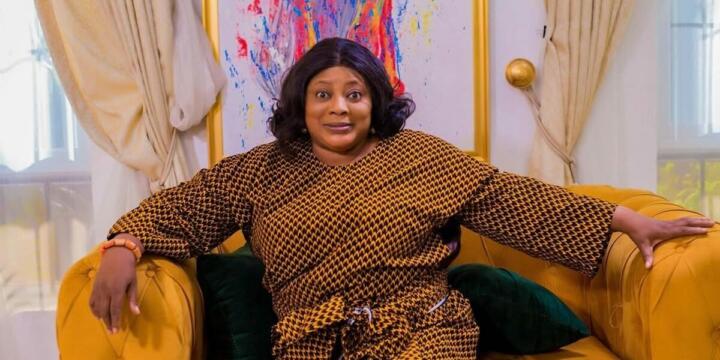
The moviestar added that studying Communication and Language Arts at the University of Ibadan makes it easier for her to communicate.
Her words, “I have been through domestic violence, and I like to talk about other people’s stories. I want us to learn together and heal together, if possible.
I like hearing about people’s challenges—what they are facing in life and how we can overcome them.
It’s a new field for me, but I studied Communication and Language Arts at the University of Ibadan, so I already have the background.
The fact that people are able to open up to me is a privilege. Being able to bring people on the show to talk about these issues means a lot. Years ago, we couldn’t discuss some of these things openly. It shows we have come a long way.”
WOW.
Nollywood is a sobriquet that originally referred to the Nigerian film industry. The origin of the term dates back to the early 2000s, traced to an article in The New York Times. Due to the history of evolving meanings and contexts, there is no clear or agreed-upon definition for the term, which has made it a subject to several controversies.
The origin of the term “Nollywood” remains unclear; Jonathan Haynes traced the earliest usage of the word to a 2002 article by Matt Steinglass in the New York Times, where it was used to describe Nigerian cinema.
Charles Igwe noted that Norimitsu Onishi also used the name in a September 2002 article he wrote for the New York Times. The term continues to be used in the media to refer to the Nigerian film industry, with its definition later assumed to be a portmanteau of the words “Nigeria” and “Hollywood”, the American major film hub.
Film-making in Nigeria is divided largely along regional, and marginally ethnic and religious lines. Thus, there are distinct film industries – each seeking to portray the concern of the particular section and ethnicity it represents. However, there is the English-language film industry which is a melting pot for filmmaking and filmmakers from most of the regional industries.
Support InfoStride News' Credible Journalism: Only credible journalism can guarantee a fair, accountable and transparent society, including democracy and government. It involves a lot of efforts and money. We need your support. Click here to Donate