
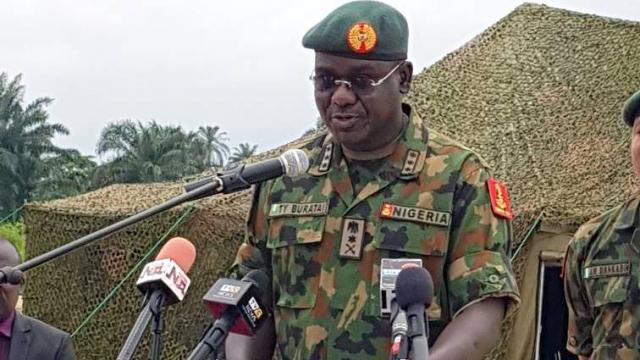
Former Chief of Army Staff, Lt. Gen. Tukur Buratai (retd.), has called for increased recruitment, continuous training and improved welfare for security personnel as part of efforts to strengthen the fight against insecurity in Nigeria.
Buratai made the call during an interview on TVC, where he spoke on the rising cases of banditry, kidnapping and the challenges confronting security operations across the country.
Reacting to concerns over the ability of criminals to communicate freely, release videos and sometimes carry out live recordings during operations, the former army chief said he does not believe security agencies lack the capacity to track them.
“I don’t think they fail to locate. If they can locate ordinary citizens or social media influencers, I don’t believe they cannot locate these bandits,” he said.
He, however, noted that there may be operational factors responsible for delays or difficulties in responding to criminal activities, stressing the need for continuous improvement in security operations.
“I would not say it is purely a capacity challenge, but there is need for continuous capacity building across all security agencies,” he added.
Buratai emphasised the need to increase manpower within the nation’s security architecture, noting that more personnel are required to effectively combat emerging threats.
“There is need for more operatives. We need more troops to be recruited, more policemen need to be trained and retrained,” he said.
He also stressed the importance of prioritising the welfare of security personnel, including improved accommodation and working conditions, to boost morale and operational efficiency.
“Their welfare is very important. They must have good accommodation and good welfare,” he stated.
Speaking on specialised rescue operations, Buratai said the Nigerian military already possesses units trained to handle high-risk missions.
According to him, the Nigerian Navy operates special boat services, while the Nigerian Army has special forces and rescue units equipped for such assignments.
“In general, we have within the military special units like the Navy special boat services, and in the Army we have special forces and rescue units. They are trained for such missions,” he said.
The former army chief, however, noted that kidnapping operations often present unique challenges, including difficult terrain, uncertainty about victims’ locations and the risk of collateral damage during rescue missions.
Buratai further advocated the strengthening of coordination among security agencies through the expansion of the counterterrorism centre under the Office of the National Security Adviser.
“The Office of the National Security Adviser has a counterterrorism centre. If it can be expanded to have state branches with highly technical equipment and good operations centres, it will improve coordination,” he said.
He explained that decentralising such structures would enhance intelligence sharing, inter-agency collaboration and response capabilities across the country.
Buratai expressed optimism that with improved manpower, welfare, training and coordination, security agencies would be better positioned to address the nation’s security challenges.
Support InfoStride News' Credible Journalism: Only credible journalism can guarantee a fair, accountable and transparent society, including democracy and government. It involves a lot of efforts and money. We need your support. Click here to Donate