
APC governorship candidate Senator Solomon Adeola, a.k.a Yayi, has visited late Ogogo’s family in Ilaro. He recently pledged to personally organise and sponsor Taiwo Hasan’s 40th-day prayer and support the family left behind.
Announcing that he had already planned to appoint Ogogo as Special Adviser on Culture and Tourism with full cabinet rank, Yayi revealed that the actor’s death dealt a severe blow to the entertainment industry, Ogun State and Nigeria at large.
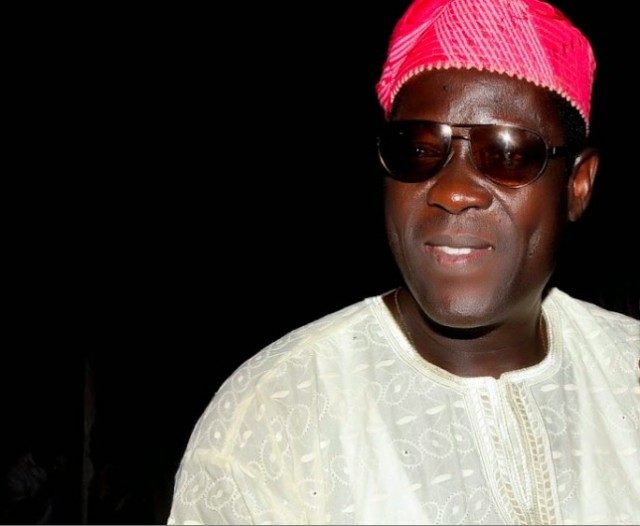
He added that even though arrangements were underway to fly the moviestar to India for advanced medical treatment, his health deteriorated rapidly before the documents could be issued.
His words, “Death was cruel for taking Ogogo away from Yewaland, Ogun State, and Nigeria as a whole. He was scheduled to be taken to India for advanced medical treatment.
We had already processed the visa applications and made all necessary travel arrangements to fly him out of the country.
However, before the visa could be issued, he became extremely weak and could no longer make the trip.
I had already planned to appoint Ogogo as my Special Adviser on Culture and Tourism with full cabinet rank if I am eventually elected as the Governor of Ogun State.
Ogogo was not just an icon affiliated with Ilaro, but an ambassador who elevated the image of the entire Ogun State and Nigeria through his craft.”
Nollywood is a sobriquet that originally referred to the Nigerian film industry. The origin of the term dates back to the early 2000s, traced to an article in The New York Times. Due to the history of evolving meanings and contexts, there is no clear or agreed-upon definition for the term, which has made it a subject to several controversies.
The origin of the term “Nollywood” remains unclear; Jonathan Haynes traced the earliest usage of the word to a 2002 article by Matt Steinglass in the New York Times, where it was used to describe Nigerian cinema.
Charles Igwe noted that Norimitsu Onishi also used the name in a September 2002 article he wrote for the New York Times. The term continues to be used in the media to refer to the Nigerian film industry, with its definition later assumed to be a portmanteau of the words “Nigeria” and “Hollywood”, the American major film hub.
Film-making in Nigeria is divided largely along regional, and marginally ethnic and religious lines. Thus, there are distinct film industries – each seeking to portray the concern of the particular section and ethnicity it represents. However, there is the English-language film industry which is a melting pot for filmmaking and filmmakers from most of the regional industries.
Support InfoStride News' Credible Journalism: Only credible journalism can guarantee a fair, accountable and transparent society, including democracy and government. It involves a lot of efforts and money. We need your support. Click here to Donate