
A former lead counsel to the leader of the Indigenous People of Biafra, IPOB, Nnamdi Kanu, Aloy Ejimakor, has described the trial of the Biafra agitator as “tough,” recounting his experience while heading Kanu’s legal team.
Ejimakor, who served as Kanu’s lead counsel for one year, made the disclosure in a video posted on his X handle, where he reflected on his role in the high-profile case.
InfoStride News recalls that Kanu was rearrested in Kenya in 2021 and subjected to what his lawyers described as extraordinary rendition back to Nigeria. On November 20, 2025, the Federal High Court in Abuja sentenced him to life imprisonment after finding him guilty of terrorism-related charges.
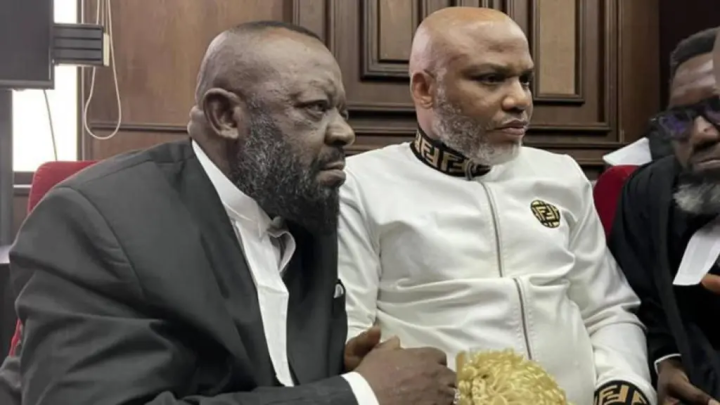
He was subsequently transferred to the Sokoto Custodial Centre to serve his sentence.
Speaking in the video, Ejimakor said his time as lead counsel was fulfilling despite the challenges associated with the case.
“My stint as lead counsel was very fulfilling and I cannot complain. I trained to handle cases even when they are this tough, such as the case of Nnamdi Kanu,” he said.
Ejimakor noted that he assumed the role of lead counsel in February 2024, adding that one of his first actions was to file an application seeking the restoration of Kanu’s bail.
According to him, the application was based on observations made by the Supreme Court when it remitted the case back to the Federal High Court.
“The Supreme Court had said, clearly in a concurring judgment, that the revocation of his bail was unfair and should not have happened. It smacked of suspicion of partiality on the part of the High Court that revoked it,” he stated.
He further explained that the Supreme Court cited with approval a January 2022 judgment of the Abia State High Court, which condemned the invasion of Kanu’s residence in September 2017 and awarded him N1 billion in damages.
“The High Court blamed that invasion as the sole reason Kanu had to leave Nigeria and failed to appear for his trial,” Ejimakor said.
He added that the Supreme Court placed responsibility squarely on the Federal Government, rejecting claims that Kanu jumped bail.
“So the Supreme Court said he didn’t jump bail,” Ejimakor noted.
Despite these findings, Ejimakor said the application for bail restoration was denied at the High Court, prompting him to appeal the decision at the Court of Appeal.
He also disclosed that he took additional steps to test whether Kanu would receive a fair trial.
“The second step I took to test whether the field of play was going to be fair was to challenge the jurisdiction of the court to subject him to trial. There were judicial issues inherent in his case,” he added.
Support InfoStride News' Credible Journalism: Only credible journalism can guarantee a fair, accountable and transparent society, including democracy and government. It involves a lot of efforts and money. We need your support. Click here to Donate