
Nollywood actress Mojisola Adebanjo has shared why she refuses to make personal or professional compromises in the Nigerian film industry. She recently had her say while speaking during an interview with Saturday Beats, and fans have been reacting.
According to her, she has learned to remain true to her principles even when pressured to conform to unhealthy industry norms because her peace of mind and values are non–negotiable.
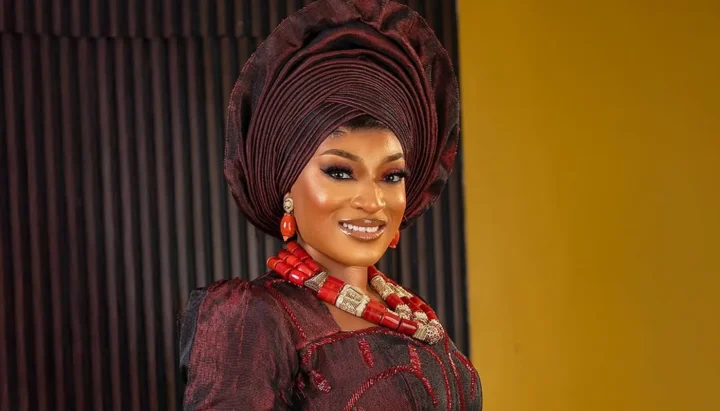
Moji added that she was once encouraged to stir unnecessary drama to advance professionally, but she declined.
Her words, “I have learnt that staying true to my values is non-negotiable. For me, that means refusing to engage in industry ‘games,’ gossip, or manipulation to fit in. I’ve seen how toxic these dynamics can be, and I prioritise peace and self-respect over forced relationships or quick fame.
There was a situation early in my career where I was pressured to participate in unnecessary drama to get ahead. I chose not to engage, and looking back, I would make the same choice again. My peace and integrity are priceless.
I have seen relationships suffer when serious issues arise, and it’s hard to watch. Couples should consider separating when there is abuse, whether it’s physical, emotional or sexual. Persistent toxic patterns like control, manipulation, or constant negativity are also major red flags.
For actors, having a side hustle isn’t just beneficial; it’s a necessity. Acting income can be inconsistent, and that’s the reality. Side hustles provide a financial cushion to cover essentials like rent and other expenses.”
WOW.
Nollywood is a sobriquet that originally referred to the Nigerian film industry. The origin of the term dates back to the early 2000s, traced to an article in The New York Times. Due to the history of evolving meanings and contexts, there is no clear or agreed-upon definition for the term, which has made it a subject to several controversies.
The origin of the term “Nollywood” remains unclear; Jonathan Haynes traced the earliest usage of the word to a 2002 article by Matt Steinglass in the New York Times, where it was used to describe Nigerian cinema.
Charles Igwe noted that Norimitsu Onishi also used the name in a September 2002 article he wrote for the New York Times. The term continues to be used in the media to refer to the Nigerian film industry, with its definition later assumed to be a portmanteau of the words “Nigeria” and “Hollywood”, the American major film hub.
Film-making in Nigeria is divided largely along regional, and marginally ethnic and religious lines. Thus, there are distinct film industries – each seeking to portray the concern of the particular section and ethnicity it represents. However, there is the English-language film industry which is a melting pot for filmmaking and filmmakers from most of the regional industries.
Support InfoStride News' Credible Journalism: Only credible journalism can guarantee a fair, accountable and transparent society, including democracy and government. It involves a lot of efforts and money. We need your support. Click here to Donate