
Nollywood actress Nkechi Blessing Sunday has blasted online strangers who pressure her to get married. She recently had her say via her social media page, and fans have been reacting.
According to her, it is very strange that marriage pressure has never come from her family, but from outsiders who only watch her on TV and have no personal connection to her.
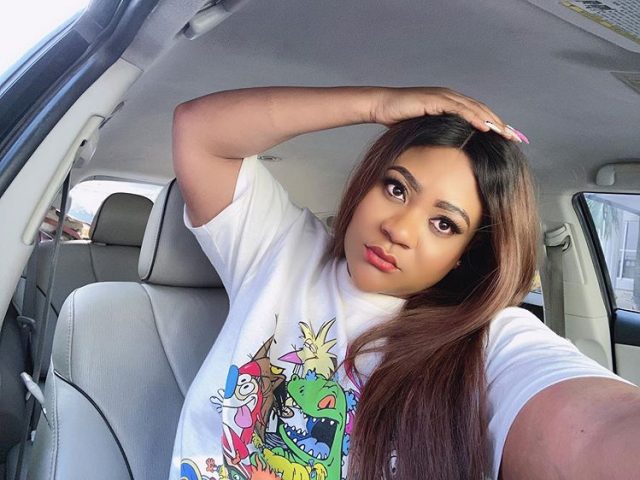
Nkechi added that her mother was a strong-willed woman who believed no one should ever force marriage on a woman.
Her words, “I didn’t come from that kind of family. It’s only these online people that are not related to me that will be telling me to go and marry. Like you’re my father or mother.
I have never dated anyone who has been violent toward me. I can say for a fact that my father used to hit my mum, but that didn’t make me feel like any man should hit me.
Even though one of my exes when I was growing up used to beat me—his name is Valentine. My mum would lock him up at the police station. And when she did, I would go there and tell the police, ‘It’s because my mother wants me to leave him for another man, that’s why she locked him up,’ even though it wasn’t true.
The police would call my mum, and she would tell them, ‘Lock am join there.’ Before you know it, play-play, they would lock me too.
Do you know who my mother was? I would stay in the cell for two days, and on the third day, she would come herself and ask them to release us. She would say, ‘Leave man.’ Before she died, she never pressured me to get married.”
WOW.
Nollywood is a sobriquet that originally referred to the Nigerian film industry. The origin of the term dates back to the early 2000s, traced to an article in The New York Times. Due to the history of evolving meanings and contexts, there is no clear or agreed-upon definition for the term, which has made it a subject to several controversies.
The origin of the term “Nollywood” remains unclear; Jonathan Haynes traced the earliest usage of the word to a 2002 article by Matt Steinglass in the New York Times, where it was used to describe Nigerian cinema.
Charles Igwe noted that Norimitsu Onishi also used the name in a September 2002 article he wrote for the New York Times. The term continues to be used in the media to refer to the Nigerian film industry, with its definition later assumed to be a portmanteau of the words “Nigeria” and “Hollywood”, the American major film hub.
Film-making in Nigeria is divided largely along regional, and marginally ethnic and religious lines. Thus, there are distinct film industries – each seeking to portray the concern of the particular section and ethnicity it represents. However, there is the English-language film industry which is a melting pot for filmmaking and filmmakers from most of the regional industries.
Support InfoStride News' Credible Journalism: Only credible journalism can guarantee a fair, accountable and transparent society, including democracy and government. It involves a lot of efforts and money. We need your support. Click here to Donate