
Iyabo Ojo’s daughter, Priscilla Ojo, has come out to speak about the emotional struggles men face. She recently had her say during an outdoor sit-down interview with content creator, Jarvis, and fans have been reacting.
Revealing that women are able to express their emotions freely from time to time, Priscilla noted that men should live the same, else bottling things up will eventually get overwhelming.
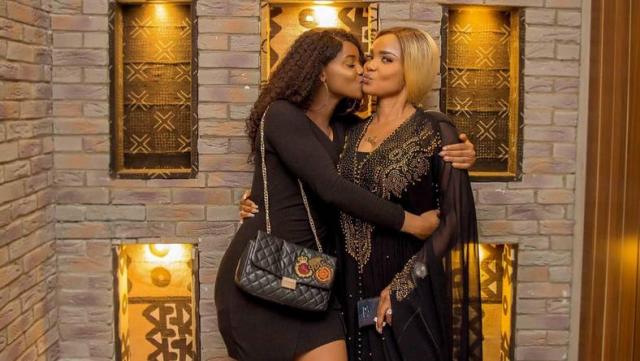
Priscilla added that she’d rather not share whether she is a Christian or Muslim now to prevent her words from being misinterpreted.
Her words, “Being a woman is not easy emotionally. We go through a lot, including childbirth, managing the home, and other responsibilities.
We are allowed to express our emotions, but men are often expected to hide theirs, regardless of what they are going through.
This conversation we are having now, when we get home, we will feel relieved.
But for men, when they return to their private spaces, it’s often just them. What many men don’t realise is that sharing helps.
They keep things bottled up until it becomes overwhelming. Life can be hard for them.”
Asked whether she is a Christian or Muslim after marriage, “I would like to skip that question because people tend to twist things.
My husband once granted an interview, and because he speaks Swahili, when Nigerian blogs picked it up, they misrepresented what he said.
They made it seem like he claimed I must be a Muslim.”
WOW.
Nollywood is a sobriquet that originally referred to the Nigerian film industry. The origin of the term dates back to the early 2000s, traced to an article in The New York Times. Due to the history of evolving meanings and contexts, there is no clear or agreed-upon definition for the term, which has made it a subject to several controversies.
The origin of the term “Nollywood” remains unclear; Jonathan Haynes traced the earliest usage of the word to a 2002 article by Matt Steinglass in the New York Times, where it was used to describe Nigerian cinema.
Charles Igwe noted that Norimitsu Onishi also used the name in a September 2002 article he wrote for the New York Times. The term continues to be used in the media to refer to the Nigerian film industry, with its definition later assumed to be a portmanteau of the words “Nigeria” and “Hollywood”, the American major film hub.
Film-making in Nigeria is divided largely along regional, and marginally ethnic and religious lines. Thus, there are distinct film industries – each seeking to portray the concern of the particular section and ethnicity it represents. However, there is the English-language film industry which is a melting pot for filmmaking and filmmakers from most of the regional industries.
Support InfoStride News' Credible Journalism: Only credible journalism can guarantee a fair, accountable and transparent society, including democracy and government. It involves a lot of efforts and money. We need your support. Click here to Donate