
Nollywood actress Queeneth Hilbert has announced that she is taking a break from social media. The moviestar recently revealed that she wants to make peace and move on as a new person, and fans have been reacting.
Tendering a heartfelt apology to her colleague, Destiny Etiko, Queeneth noted that many people kept badmouthing her to the actress and vice versa.
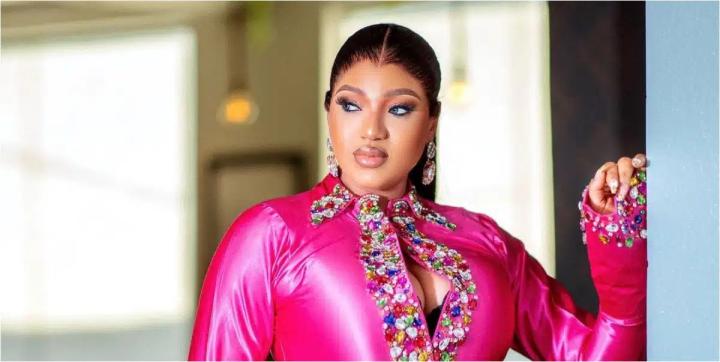
She then promised never to be in the midst of any blabbermouths or gossip mongers again.
Her words, “Dear Destiny, you know the truth, and I know how hurt you are and have been, but these people wouldn’t let me be.
They gossip you to me and gossip me to you.
They’re called Blabbermouth and Gossip Monger. I know a whole lot more I would write, and only you and your God.
I’m telling the truth, and I get it if it takes you millions of years to heal, cause I would do the same.
Forgive your girl and forget. I’ve got your back, and I’m ready to take any lash from anyone, cause your heart is rare, seriously.
I never knew all these things. I was on my own, and they brought it to me, and maybe your post and characters made it seem as if they were right, but I have learnt better now, and I’m sure you have too.
I’m so broken as I drop this.
Today, I am officially announcing that I will be off Social media has been around for a while to fix certain things
And make peace with some certain spirits …
I will move on as a new person and never be in the Midst of any blabber mouths or gossip mongers again
Thank you for all the love, and God bless you
I don’t take you guys love for granted, thank you
I have satisfied my conscience, kisses.”
WOW.
Nollywood is a sobriquet that originally referred to the Nigerian film industry. The origin of the term dates back to the early 2000s, traced to an article in The New York Times. Due to the history of evolving meanings and contexts, there is no clear or agreed-upon definition for the term, which has made it a subject to several controversies.
The origin of the term “Nollywood” remains unclear; Jonathan Haynes traced the earliest usage of the word to a 2002 article by Matt Steinglass in the New York Times, where it was used to describe Nigerian cinema.
Charles Igwe noted that Norimitsu Onishi also used the name in a September 2002 article he wrote for the New York Times. The term continues to be used in the media to refer to the Nigerian film industry, with its definition later assumed to be a portmanteau of the words “Nigeria” and “Hollywood”, the American major film hub.
Film-making in Nigeria is divided largely along regional, and marginally ethnic and religious lines. Thus, there are distinct film industries – each seeking to portray the concern of the particular section and ethnicity it represents. However, there is the English-language film industry which is a melting pot for filmmaking and filmmakers from most of the regional industries.
Support InfoStride News' Credible Journalism: Only credible journalism can guarantee a fair, accountable and transparent society, including democracy and government. It involves a lot of efforts and money. We need your support. Click here to Donate