
Nollywood actress Rosy Meurer has traded words with trolls over her multiple posts following her husband Olakunle Churchill’s reconciliation with his ex, Tonto Dikeh. She recently had her say via her social media page, and fans have been reacting.
According to her, making posts online is part of her source of income, so trolls should not expect her to stop eating anytime soon.
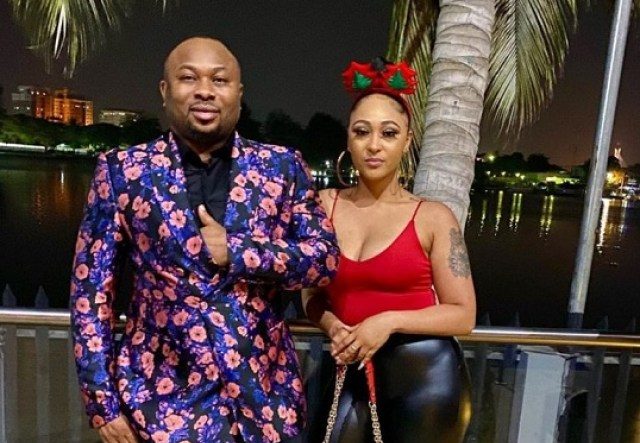
Rosy added that anyone who doesn’t like her posts and content should block her immediately.
The troll wrote, “You’re now doing too much, Rosy. For over a month now, you’ve been doing this back-to-back. For what exactly? To make people think that you’re fine when you aren’t? Do you really need to show people that you’re fine? If yes, why now? I’d advise you to stop.
Do other things. This is not who you are.
Nobody really cares.
You shouldn’t give a fvck.
No offence, though.
Enjoy the rest of your evening.”
She responded, “My sister, this is part of my source of income. I no fit leave am for anyone biko. Allow me eat na.
Make I be lazy youth? Allow me na. It’s my page, it’s my eating. It’s my hate comments, allow me eat them in peace na.
If I post 100 a day and you don’t like it, unfollow me, block me, the options are plenty.
Lol, I’m not here to entertain you na. Page plenty for this Instagram. Follow the ones that aren’t boring.”
WOW.
Nollywood is a sobriquet that originally referred to the Nigerian film industry. The origin of the term dates back to the early 2000s, traced to an article in The New York Times. Due to the history of evolving meanings and contexts, there is no clear or agreed-upon definition for the term, which has made it a subject to several controversies.
The origin of the term “Nollywood” remains unclear; Jonathan Haynes traced the earliest usage of the word to a 2002 article by Matt Steinglass in the New York Times, where it was used to describe Nigerian cinema.
Charles Igwe noted that Norimitsu Onishi also used the name in a September 2002 article he wrote for the New York Times. The term continues to be used in the media to refer to the Nigerian film industry, with its definition later assumed to be a portmanteau of the words “Nigeria” and “Hollywood”, the American major film hub.
Film-making in Nigeria is divided largely along regional, and marginally ethnic and religious lines. Thus, there are distinct film industries – each seeking to portray the concern of the particular section and ethnicity it represents. However, there is the English-language film industry which is a melting pot for filmmaking and filmmakers from most of the regional industries.
Support InfoStride News' Credible Journalism: Only credible journalism can guarantee a fair, accountable and transparent society, including democracy and government. It involves a lot of efforts and money. We need your support. Click here to Donate