
Veteran Nollywood filmmaker, Tunde Kelani, has advised young creatives to remain rooted in their cultural identity. He recently had his say while speaking during an interview with Saturday Beats, and Nigerians have been reacting.
Warning that excessive reliance on digital tools could dilute originality in storytelling, Kelani urged Nigerian creatives to be careful while embracing modern technology.
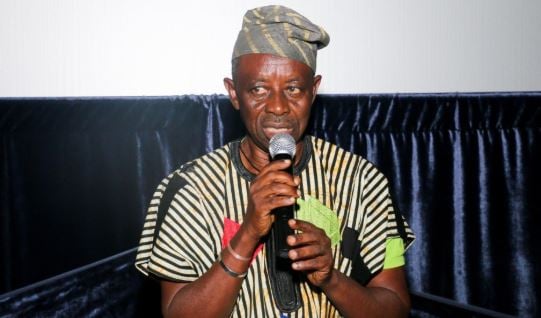
He further emphasised the importance of African storytelling and the need for filmmakers to continually draw from indigenous heritage.
His words, “When you mention Africa, we are talking about 50 countries, over 2,000 languages and cultures. That is our strength. We must go back and unearth our intangible heritage.
Don’t get carried away with technology; concentrate more on your essence. But use the technology to tell your own story. Don’t forget what we have. Our strength is in our own architecture, our palaces, our colours. We must capture the cinematic realism of our circumstances and culture.
What has made me relevant over the years is my passion. I am one of the individuals who have the greatest passion for what I am doing. I still continue, so each film is a journey of expression to me. And I simply continue to do it.”
WOW.
Nollywood is a sobriquet that originally referred to the Nigerian film industry. The origin of the term dates back to the early 2000s, traced to an article in The New York Times. Due to the history of evolving meanings and contexts, there is no clear or agreed-upon definition for the term, which has made it a subject to several controversies.
The origin of the term “Nollywood” remains unclear; Jonathan Haynes traced the earliest usage of the word to a 2002 article by Matt Steinglass in the New York Times, where it was used to describe Nigerian cinema.
Charles Igwe noted that Norimitsu Onishi also used the name in a September 2002 article he wrote for the New York Times. The term continues to be used in the media to refer to the Nigerian film industry, with its definition later assumed to be a portmanteau of the words “Nigeria” and “Hollywood”, the American major film hub.
Film-making in Nigeria is divided largely along regional, and marginally ethnic and religious lines. Thus, there are distinct film industries – each seeking to portray the concern of the particular section and ethnicity it represents. However, there is the English-language film industry which is a melting pot for filmmaking and filmmakers from most of the regional industries.
Support InfoStride News' Credible Journalism: Only credible journalism can guarantee a fair, accountable and transparent society, including democracy and government. It involves a lot of efforts and money. We need your support. Click here to Donate